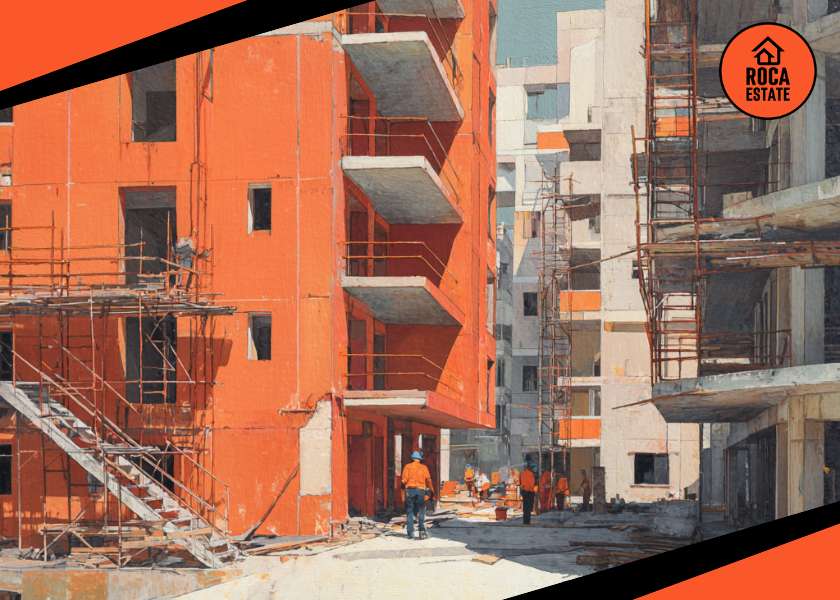
According to the latest data from Portugal’s National Statistics Institute (INE), year-on-year Portugal Construction Costs for New Housing accelerated to 7.5% in August 2026, up 1.0 percentage point from the 6.5% rate recorded in July. Building material prices grew 7.1% year-on-year, while labor expenses increased by 8.0%. This ongoing inflationary trend creates new strategic realities for institutional players planning investments in property in Portugal. As highlighted in our earlier market analysis on July’s cost moderation, tracking these monthly shifts is critical for controlling development budgets, protecting gross initial yield, and mitigating downside risks.
Key Data Breakdown: August 2026 Index Movement
The August metrics reveal broader cost pressures across all major input categories:
- Portugal Construction Costs for New Housing: Accelerated to 7.5% year-on-year, pushing overall capital expenditure higher across greenfield developments.
- Portugal Construction Material Prices: Rebounded sharply to 7.1% year-on-year, ending the period where materials insulated development budgets.
- Portugal Construction Labour Costs: Expanded by 8.0% year-on-year as persistent structural shortages in skilled trade labor continue to drive wage increases.
Construction cost index for new residential dwellings
Impact on Portugal Real Estate Development Costs and Yield Compression
Escalating Portugal real estate development costs compress the spread between gross initial yields and underlying risk-free rates. When overall construction expenditures outpace broader inflation, unhedged forward-funding structures face immediate margin erosion.
1. Underwriting and Cap Rate Sensitivity
Developer profit margins are thinning. As base input costs increase by 7.5% annually, static exit valuation assumptions expose equity investors to unexpected downside. Real estate developers must evaluate how rising base costs directly affect project viability:
If terminal cap rates compress or remain flat while total development budgets expand, net project returns decline significantly.
2. Labor Scarcity and Schedule Slippage
At 8.0% year-on-year growth, labor remains the single largest driver of cost escalation. High demand for skilled trade labor creates wage pressure and extends execution timelines. Schedule delays increase debt service costs, eroding overall internal rates of return (IRR).
3. Material Cost Dynamics
Material costs were relatively stable earlier in the year, but their acceleration to 7.1% signals renewed price inflation across key supply chains. Fixed-price procurement contracts are becoming essential to protect development budgets.
Strategic Outlook: Protecting Portugal Property Development Profitability
Maintaining Portugal property development profitability requires disciplined risk management and active cost control. Real estate investors and asset managers should closely track several core market indicators:
- Labor vs. Material Price Disparity: Monitor whether labor remains the dominant driver or if Portugal residential construction costs face a secondary inflationary push from materials.
- Contractor Balance Sheet Health: General contractors tied to fixed-price commitments under inflating input costs carry higher default risk, making rigorous balance sheet due diligence vital.
- Land Value Re-anchoring: Unimproved land prices must adjust downward to absorb higher construction budgets without squeezing developer returns.
- Pre-Leasing and Forward Sales: Securing early commitments helps reduce market absorption risks as total project delivery costs rise.
Strategic Conclusion & Risk Management
The August 2026 figures demonstrate that residential construction inflation remains a critical execution risk in Portugal. Capital allocators must move beyond aggressive growth models and prioritize strict cost governance.
To preserve risk-adjusted returns, sponsors must integrate conservative contingency buffers (10–15%), lock in early fixed-price procurement agreements, and stress-test terminal exit yields against potential rate shifts. While structural demand across primary Portuguese urban centers remains robust, protecting margins requires disciplined underwriting from the outset.
Partner with Roca Estate
Navigating capital allocation and investments in property in Portugal requires localized expertise and data-driven underwriting. Reach out to the team at Roca Estate to discover how our advisory and development management services protect yield and optimize real estate portfolios across Portugal.