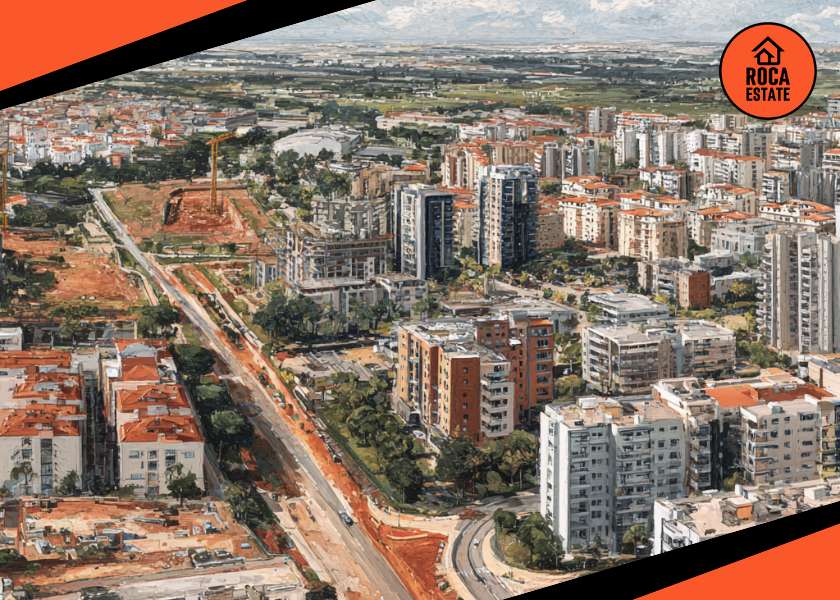
Portugal Construction Market Trends continue to provide critical insight into the underlying conditions shaping commercial property performance. According to the latest data from INE, construction activity in November 2025 remained in positive territory, confirming ongoing expansion while also signaling a gradual loss of momentum. For investors engaged in real estate investment in Portugal, these indicators serve as an early warning system for supply dynamics, cost pressures, and development feasibility across key commercial segments.
This monthly briefing examines the latest construction production, employment, and wage data through an investment lens. Rather than treating construction metrics as standalone statistics, the analysis focuses on their implications for capital deployment, risk management, and timing within Portugal’s commercial real estate cycle. As financing conditions remain selective and cost discipline becomes increasingly important, understanding how construction trends evolve is essential for informed investment decision-making.
Construction Output Remains Positive, but Growth Is Normalizing
Construction production rose 3.0% year-on-year in November, slightly below the pace recorded in October. While the headline figure confirms continued growth, the marginal slowdown is meaningful. It suggests the sector is transitioning from post-pandemic recovery into a more mature phase of the cycle.
Segment-level performance highlights this shift:
- Building construction increased 3.2% year-on-year, moderating from the previous month.
- Civil engineering accelerated modestly to 2.8%, supported by infrastructure and public-sector projects.
From a Portugal commercial real estate investment perspective, building construction is the more relevant indicator. Its deceleration points to increasing selectivity among private developers, reflecting tighter financing conditions and a higher bar for project viability.
New commercial supply is becoming more disciplined, reducing the risk of near-term oversupply in core office, logistics, and mixed-use markets.
Employment and Wage Growth Highlight Structural Cost Pressure
While output growth softened slightly, labor indicators moved sharply higher. Construction employment expanded 2.7% year-on-year, while remuneration rose 8.2%, marking a clear acceleration in wage growth.
This divergence is critical when analyzing Portugal construction market trends. Rising wages despite moderating output signal persistent labor constraints rather than cyclical overheating. For investors, this has direct consequences for development underwriting and asset strategy.
Key implications include:
- Higher and more volatile construction costs across development and refurbishment projects
- Increased execution risk for repositioning strategies reliant on heavy capex
- Greater importance of rental growth assumptions in prime, supply-constrained locations
Cost inflation, not demand weakness, represents the primary downside risk for commercial real estate projects in Portugal entering 2026.
Short-Term Fluctuations vs. the Broader Market Signal
Month-on-month indicators showed some volatility, including a slight decline in employment versus October. However, these movements are less relevant than the broader trend shaping the market.
Taken together, the data points to a late-expansion environment:
- Demand remains intact across most commercial segments
- Financing conditions are enforcing greater discipline
- Cost pressures are acting as a natural brake on new development
For Portugal commercial real estate investment, this environment typically favors income-focused strategies, stabilized assets, and locations with structural supply constraints rather than speculative development plays.
Forward-Looking Indicators Investors Should Monitor
As we move into early 2026, investors tracking Portugal construction market trends should focus on three key signals:
- Sustainability of wage growth
Continued remuneration growth above historical averages would further compress development margins. - Gap between civil engineering and building construction
A widening divergence would confirm that public investment is driving activity more than private real estate development. - Revisions and response stability in official data
Recent revisions have been modest, increasing confidence in the reliability of short-term trend analysis.
These indicators will help investors assess whether current conditions represent a temporary plateau or a longer-term rebalancing of the market.
Strategic Conclusion: Applying Construction Data to Investment Decisions
The November figures reinforce a critical takeaway for Portugal commercial real estate investment: the market is not overheating, but it is becoming less tolerant of execution errors.
Construction activity remains supportive of long-term fundamentals, yet rising labor costs and moderating growth argue for a more selective approach. Investors are likely to outperform by prioritizing:
- Assets with pricing power and short reletting cycles
- Markets where new supply is structurally constrained
- Development strategies that limit cost exposure or lock in pricing early
In the current phase of the cycle, Portugal construction market trends should be viewed less as a signal of growth potential and more as a tool for risk management. As 2026 approaches, disciplined capital deployment and cost control will be the defining factors separating resilient portfolios from underperforming ones.
Roca Estate provides data-driven advisory and sourcing services for international investors seeking disciplined opportunities in real estate investment in Portugal. Our approach combines local market intelligence with rigorous risk analysis to support informed, long-term capital allocation decisions.